Autonomy Lab
Exploring how AI systems can keep working on a mission with explicit limits, persistent evidence and independent checks.
The design separates mission control, disposable execution, persistent evidence, independent judgment and operator recovery.
Current design intent. This is not yet an implemented or proven production system.
Architecture overview
The mission and its evidence persist outside the worker. Execution can be replaced; its output still needs scrutiny.
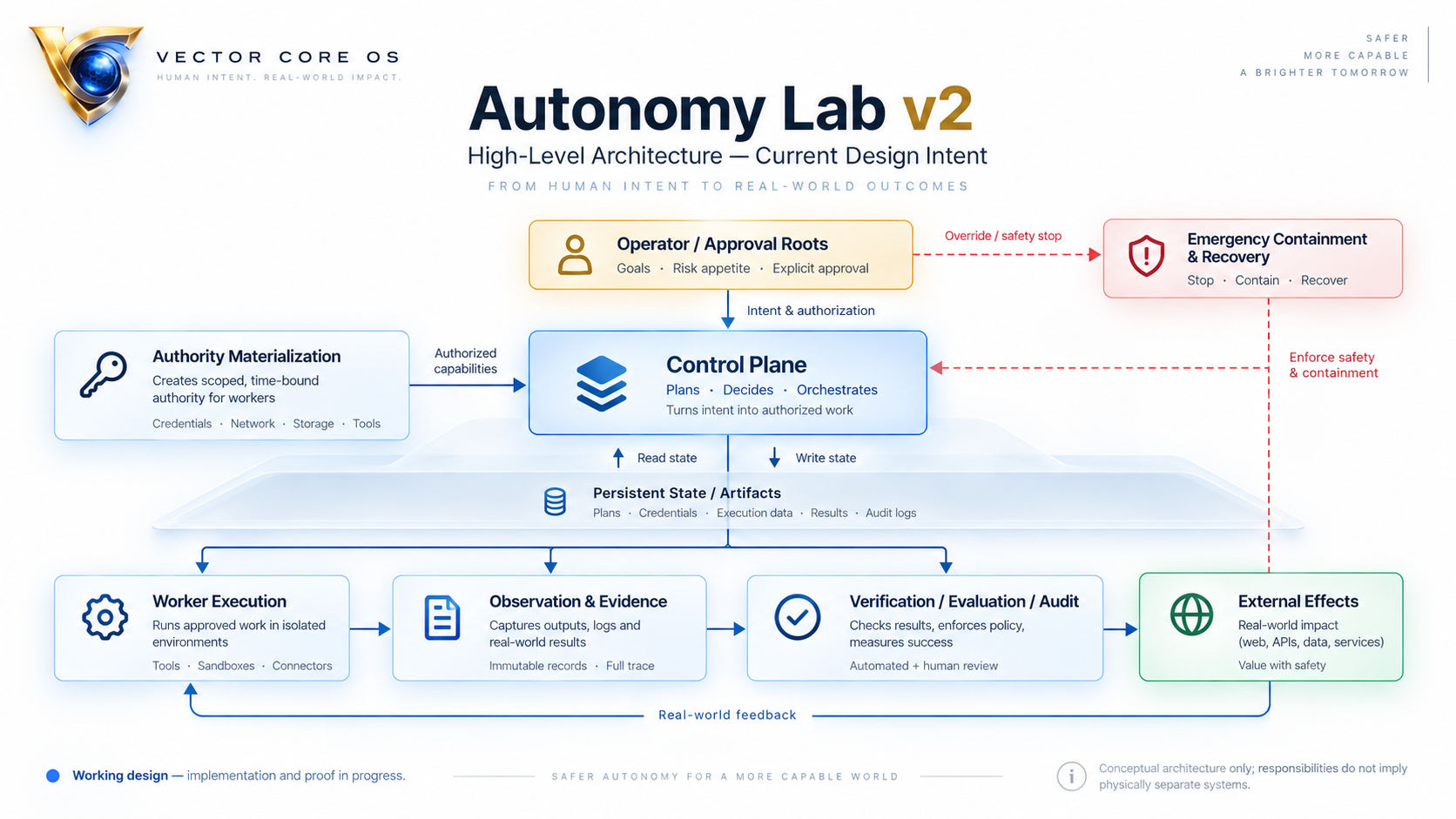
Reading the design
- The operator approves authority; protected definitions establish what that authority means.
- The planner proposes work. Mission control admits it and maintains authoritative mission state.
- Runtime, credential and network authority are distinct. Worker execution is disposable and assumed compromisable.
- Observations and retained evidence support specialist judgments. Control applies the acceptance policy before committing the outcome.
- Containment and recovery are separate responsibilities. Remote effects can outlive local containment.
- Persistent artifacts remain fallible. More-privileged consumers must admit their use.
The supplied drawings describe design goals. Their isolation, safety and implementation-progress labels do not establish that those properties have been implemented or demonstrated.
Architecture detail
The expanded view separates authority materialization from execution and shows observation, retained evidence and specialist judgment.
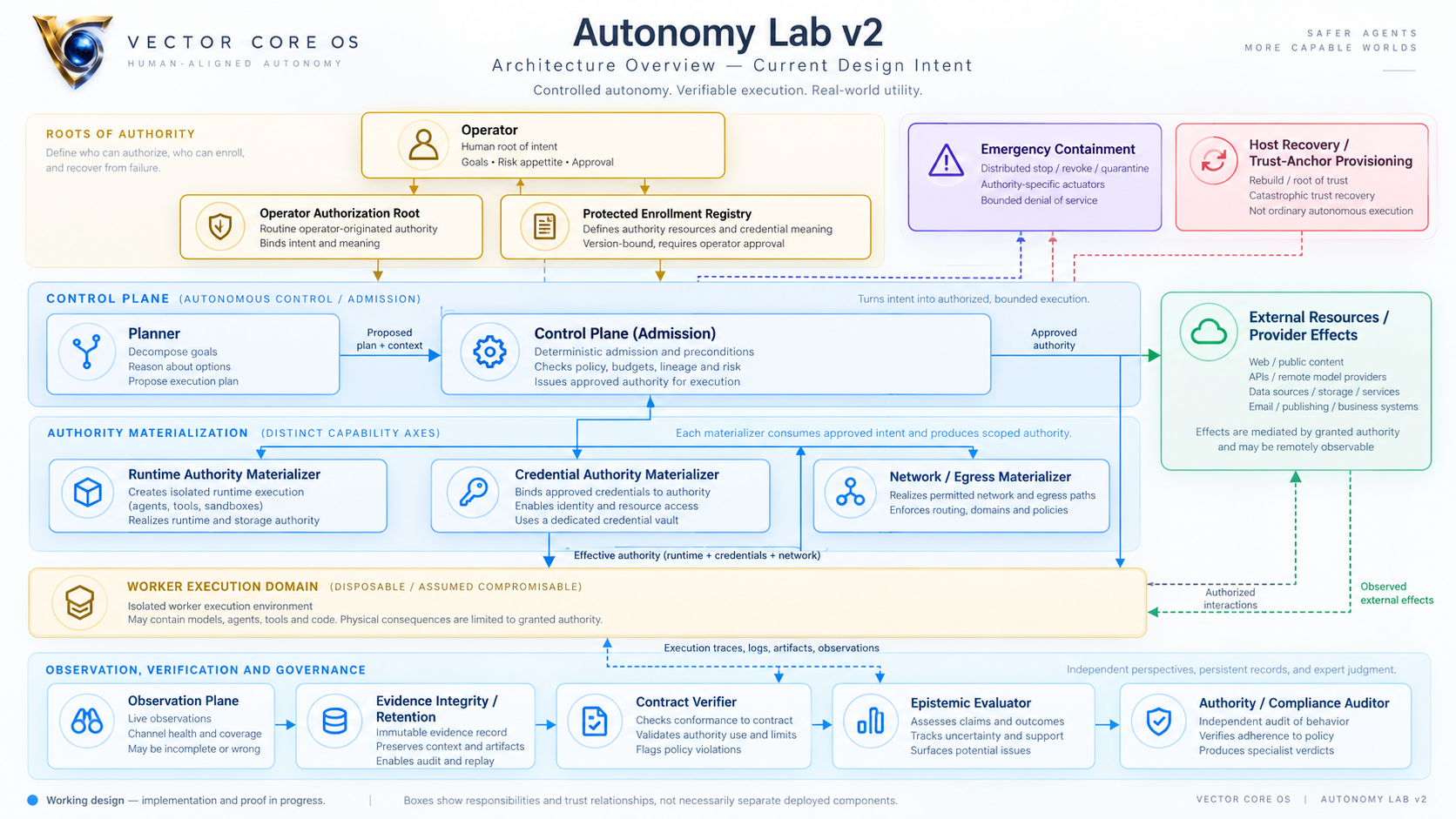
Credential custody is not one universal vault. Observation can be incomplete or wrong, and retaining a record does not make its claims true.
Full architecture
The deep reference includes the authority boundaries, persistent artifacts, consumer admission, containment and recovery relationships.
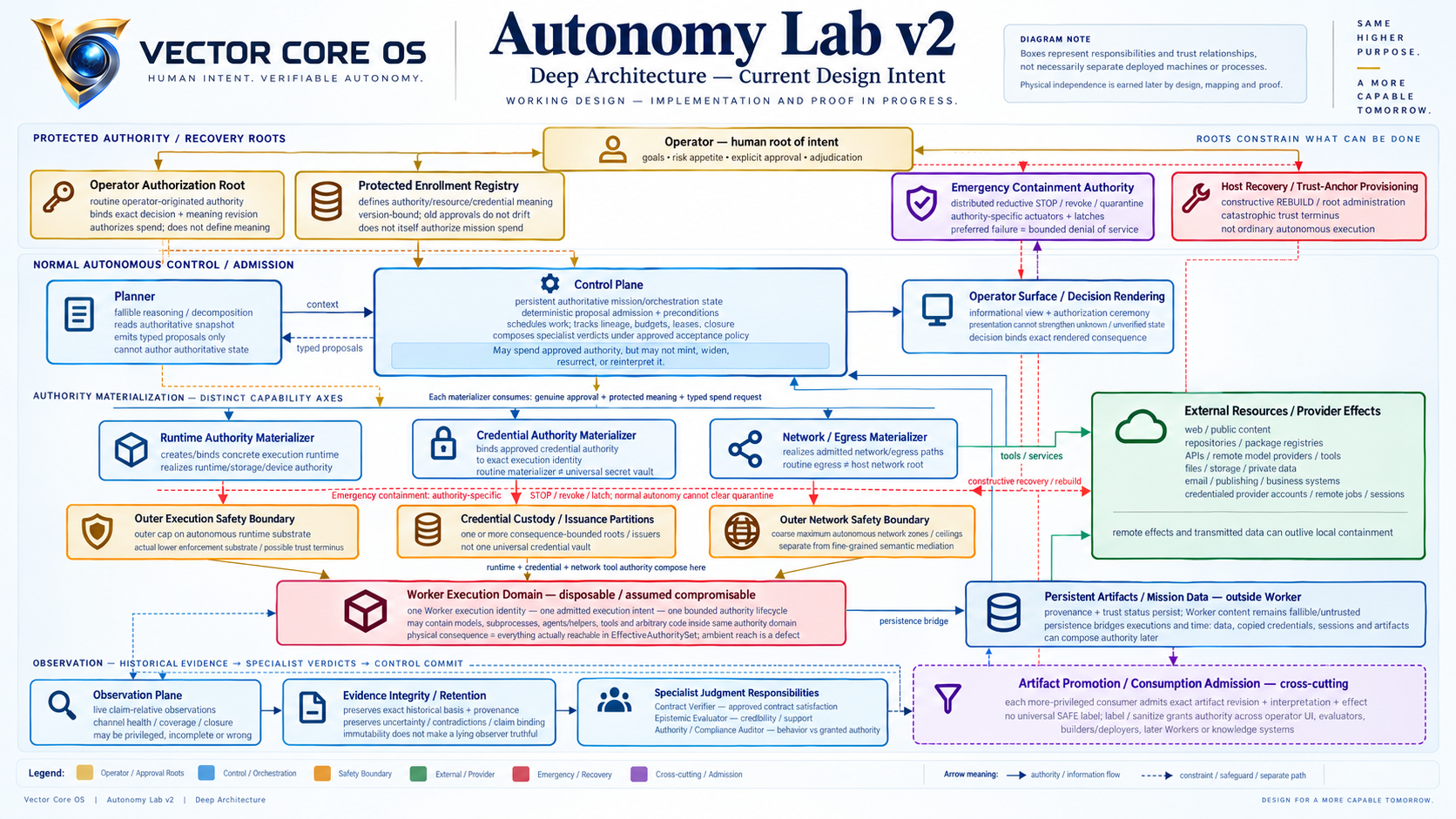
The planner reads context from control and returns typed proposals. Specialist verdicts return to control for a policy-governed decision. Physical independence must be established through implementation mapping and proof.
What still has to be proved
A diagram can separate responsibilities. Implementation has to enforce those separations. Proof has to show where they hold, where they fail, and what remains outside them.
Design what should be true. Build what can actually be enforced. Prove the difference.